


Our featured work of art for this month is this imposing and wonderfully animated Japanese, lacquered-wood Okimono depicting the Toad Immortal, Gama Sennin.
(As always with our articles and short-stories, you can click on any of the images to take a look at the piece in question.)

Of all the supernatural and mythological figures found in Japanese folklore, few are as unusual and mysterious as Gama Sennin.

The Japanese word Sennin, refers to an immortal or transcendent being. It is a concept that originated in China where “Xian” were legendary figures who achieved extraordinary longevity or immortality through spiritual cultivation, meditation, alchemy and a life of isolation.

As with many Chinese Deities and mythical characters, the idea of the Xian eventually reached Japan where Sennin became synonymous with religious traditions, folklore, literature, art and in more recent times, mediums such as anime and video games.

Sennin were often found in and amongst remote mountain ranges. The mountain is an important setting in Japanese folklore.

Mountains were traditionally regarded as places where the human world met the supernatural. Buddhist practitioners, mountain hermits, and religious specialists withdrew into remote landscapes in search of spiritual enlightenment and awareness.

This tradition can be seen particularly clearly in Shugendō, a Japanese mountain ascetic tradition whose practitioners, known as Yamabushi, undertook demanding religious practices in mountainous environments. The idea of a supernatural hermit living deep in the mountains therefore had a familiar place within Japanese imagination. An immortal such as Gama Sennin could be envisioned as belonging to a mysterious world, distant from ordinary society and possessing knowledge acquired through extraordinary spiritual discipline.

Sennin had powers unobtainable by ordinary folk and sometimes, unusual physical abilities, extraordinary lifespans and relationships with magical animals. As his name suggests, Gama Sennin is an immortal sage whose identity is closely associated with the Toad. (Gama in Japanese). In fact, it is said that Gama Sennin was able to assume the shape of a Toad.

It is believed that the origin of Gama Sennin’s character is based on Liu Hai, a 10th Century Chinese alchemist and civil servant. Liu Hai was believed to have learned the secret of immortality from a three-legged toad.

The toad is particularly suited to folklore because of its association with water, earth, darkness, and seasonal change. Like many amphibians, it appears and disappears according to its environment. Its life cycle also provides a natural metaphor for transformation.

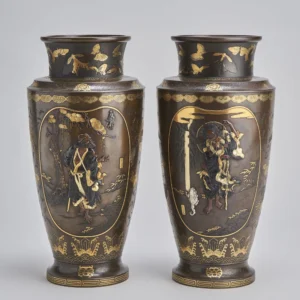
Gama Sennin was sometimes depicted alongside Tekkai Senninn (Li Tieguai in Chinese.) The two Sennin were paired because of their corresponding supernatural powers. Tekkai Sennin was thought to be capable of leaving his body and travelling for extended periods. You can see Gamma Sennin and Tekkai Sennin on this exceptional pair of Bronze and multimetal vases by the Miyao Company of Yokohama.
This particular, large-scale (68cm in height) Okimono (our featured work of art this month) is full of creativity, artistry, humour and imagination. Gama Sennin with a gleeful expression on his face as a giant Toad rests on his tousled, matted hair.

He is barefoot, dressed in robes cobbled together with multi-coloured leaves held together at the waist by a piece of old rope. He leans on a gnarled wooden staff, his unkempt appearance in keeping with his outdoor “all weathers” lifestyle.

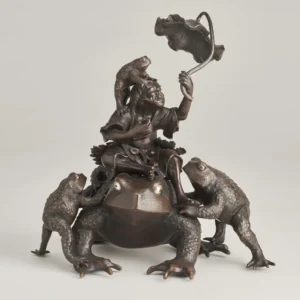
In another (equally unusual) Okimono from our collection of Japanese Meiji-era (1868-1912) art, Gama Sennin sits atop a giant Toad using a large lily leaf to help protect him and his amphibian companions from the rain.
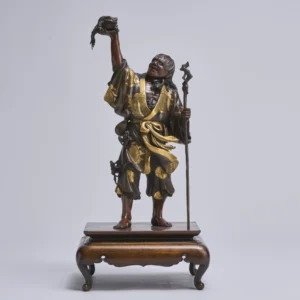
and in another, “Miyao-style” Bronze and parcel gilt Okimono, the Toad Immortal holds his companion aloft as if presenting it to the Gods. Smaller Toads clamber all over his robes.
It doesn’t surprise us that this most-unusual character with all his magical powers, mystical presence and characterful demeanour is one of the most popular figures of Japanese legend.
We hope you have enjoyed this article. If you have, you will find over 150 short stories and blogs inspired by our collection of Oriental Art by Clicking Here.