

We recently added two fascinating (and very amusing) Japanese, Meiji-era wood carvings to our website – each, brilliantly depicting a family of Monkeys aboard home-made rafts. It got us thinking about Japan’s rich history of anthropomorphism.

As with all our blogs and short-read articles, you can Click on any of the images to take a closer look at the piece in question.

Japan has a long and fascinating tradition of anthropomorphism – the practice of giving human qualities, emotions and personalities to animals, objects and even natural forces.

A troop of Macaques enjoying a traditional Japanese neck-wrestling game on this Meiji-era Iron and multi-metal box.
From ancient folklore and literature to modern anime, video games and advertising, anthropomorphism is deeply woven into Japanese culture.
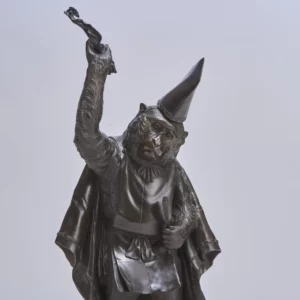
A Monkey dressed up as a Scholar in this large Bronze Okimono (Circa 1880)
One reason for this can be found in Shintoism, Japan’s traditional religion. Shintoists believe that everything, (both living and inanimate) has a spirit and the practice of Shintoism places importance on “Kami” – spiritual beings associated with nature, places and objects. Mountains, rivers, trees and other elements of the natural world are viewed as having a spiritual presence.

For example, Japan’s most recognisable natural landmark, Mount Fuji is revered as a living, sacred entity that bridges the earthly world and the divine. You can read our blog about Mount Fuji “The Never Dying Mountain” by Clicking Here.
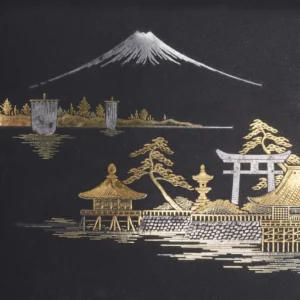
Hanakotoba or “The language of flowers” is a centuries-old cultural tradition that assigns meanings to different flowers and is commonplace in culture, literature art and everyday life. Read the blog by Clicking on the image below.

Some of the earliest known depictions of anthropomorphism are the “Scrolls of frolicking humans and animals”. These date back to the 12th and 13th Centuries and show many different animals including Monkeys, frogs and rabbits engaged in human activities.

A Samurai-like procession of Grasshoppers and other insects on this outstanding Oshi-e tapestry
These subjects are widespread across all forms of Japanese art and often lend themselves to humorous depiction, which is the key to their longstanding appeal.
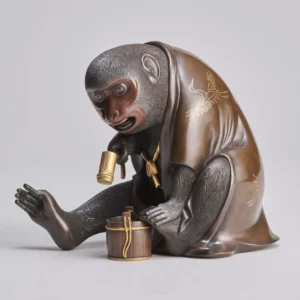
An amusing depiction of a Monkey, wearing robes and excitedly pouring scooping wine from a barrel
Today, anthropomorphism remains especially visible in Japanese popular culture. Animals, food and household objects are frequently represented as characters in anime, manga, and video games. Characters such as Hello Kitty demonstrate how a simple animal-like figure can be given human expressions and personality while becoming a major cultural icon.

A determined army of Toads on the march on this wonderful Japanese Oshi-e tapestry
Anthropomorphism in Japan is more than just making objects of animals “cute”. It reflects a broader, cultural fascination between humans, nature, objects and spirits. It creates a perspective in which the boundary between humans and the non-human world can feel more accessible, relatable and less rigid.
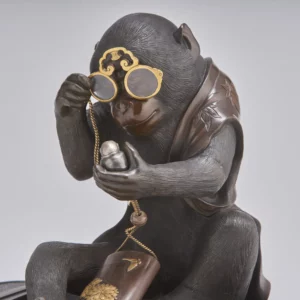
A scholarly Monkey studies a Netsuke in the form of a…. scholarly Monkey. Just brilliant
We hope you enjoyed this short-read blog. If you did, you can find over 150 articles and stories inspired by our collection of Chinese and Japanese Fine Art and Antiques by Clicking Here.